Resources

Sunday, September 30, 2012

Just Another Mobile Phone Blog: 7 ways the Snapdragon S4 makes the Nokia Lumia 920 amazing

Just Another Mobile Phone Blog
// via fulltextrssfeed.com
7 ways the Snapdragon S4 makes the Nokia Lumia 920 amazing
Sep 30th 2012, 18:31


More magnificent reasons to get very excited about the world's most innovative smartphone.

Thanks to mind-blowing innovations from chip manufacturers like Qualcomm, we're taking more pictures, watching higher quality video, and surfing faster than ever on our smartphones. But what does the future hold? With the Nokia Lumia 920 and 820 set to hit shelves soon, we've taken a look at how the processor that powers them, Qualcomm's revolutionary Snapdragon S4, will make your smartphone experience even more amazing.
1. Lower Power Consumption

First, let's talk power consumption. The Snapdragon S4 processor has been transitioned to a 28nm process (from 45nm), which makes it smallest in the industry, yet it still packs in more transistors. This new process also reduces leakage so that the chip consumes very little energy, helping your smartphone battery last all day.

What's more, it stays cool to the touch. To see how much cooler check out this experiment Qualcomm performed with a Snapdragon S4 and some butter. (Yeah, you heard right!)

2. Better Performance

The S4 also introduces a new CPU and GPU, which work in concert to make the Windows Phone 8 experience lightning fast. Now that Windows Phone 8 supports multi-core processing, the Nokia Lumia 920 and 820 can fully take advantage of Snapdragon's multiple Krait CPU cores.

In other words, even the most sophisticated apps and complex user interfaces will run buttery smooth. Paired with the new Adreno 225 GPU, the new Lumias also promise to bring console quality gaming and even more stunning graphics.

3. Lightning-Fast 4G Connectivity

For most of us, mobile surfing is one of the joys of owning a smartphone. With 4G LTE, you can surf the Web, video conference, or play multiplayer games at up to 10 times the speed of conventional 3G.

Although previous 4G LTE implementions used to come at the expense of battery life, that's no longer the case with Snapdragon's integrated LTE multimode modem. By combining the modem and application processor, having Snapdragon in your phone means better battery life no matter what the connection speed is.

4. Higher Definition

One thing that really makes a smartphone special is the quality of its graphics. Within the Snapdragon S4 processor, you'll find the Adreno 225 GPU. This both improves overall graphics performance and saves power in the process. The proof is in how fast your web browser displays pages, how quickly your navigation app responds, and of course, how amazing your favorite game looks when playing it.

It's the same graphics component that'll enable the Nokia Lumia 920 and 820 to not only play the latest DirectX 3D games, but also drive HD content and support 720p displays at 60fps. If you're a gamer, prepare to be wowed!

5. Better Security

Unfortunately, mobile hacking is becoming increasingly common, and the problem looks set to get worse. Fortunately, the Snapdragon S4 incorporates Qualcomm's Secure MSM™. This is hardware and software-based security measures that provide features such as encrypted boot, secure code signing service, and Trustzone SEE.  

6. Cooler Camera

Thanks to PureView technology and Snapdragon's Image Signal Processor (ISP), the Nokia Lumia 920 has an incredible camera.

Coupled with the S4's zippy performance, you can take your video and photo experience to new heights. Get ready to enjoy silky smooth 1080p video capture and overall speed and image quality enhancements, including image stabilization.

7. Faster Location Services

Unlike some smartphones, Nokia Lumias use mapping software that you can rely on. The Snapdragon S4 makes it even more accurate by featuring support for both GPS and GLONASS.

Once you have access to both satellite networks, your phone can determine your location quicker and within a 2 meter radius. What's more, you'll get fewer service interruptions.

You are receiving this email because you subscribed to this feed at blogtrottr.com.

If you no longer wish to receive these emails, you can unsubscribe from this feed, or manage all your subscriptions

Just Another Mobile Phone Blog: Sony Mobile Model #: LT30a (PM-0140-CV)

Just Another Mobile Phone Blog
// via fulltextrssfeed.com
Sony Mobile Model #: LT30a (PM-0140-CV)
Sep 30th 2012, 18:45


Certified Product Detail

Below are all of the certified HW/SW versions of this product.

Manufacturer: Sony Mobile
Model #: LT30a (PM-0140-CV)
Supported Technologies
and Frequency Bands: E-UTRA FDD: Band 2/Band 4/Band 5/Band 17, GSM: 850/900/1800/1900, UMTS FDD: Band I/Band II/Band IV/Band V

HW Version SW Version Request Type Date Certified
A 7.0.A.1.303 Variant Sep 25, 2012

You are receiving this email because you subscribed to this feed at blogtrottr.com.

If you no longer wish to receive these emails, you can unsubscribe from this feed, or manage all your subscriptions

Just Another Mobile Phone Blog: Sony Mobile Model #: LT30p (PM-0030-BV)

Just Another Mobile Phone Blog
// via fulltextrssfeed.com
Sony Mobile Model #: LT30p (PM-0030-BV)
Sep 30th 2012, 18:44


Certified Product Detail

Below are all of the certified HW/SW versions of this product.

Manufacturer: Sony Mobile
Model #: LT30p (PM-0030-BV)
Supported Technologies
and Frequency Bands: GSM: 850/900/1800/1900, UMTS FDD: Band I/Band II/Band IV/Band V/Band VIII

HW Version SW Version Request Type Date Certified
A 7.0.A.1.303 Variant Sep 25, 2012

You are receiving this email because you subscribed to this feed at blogtrottr.com.

If you no longer wish to receive these emails, you can unsubscribe from this feed, or manage all your subscriptions

Just Another Mobile Phone Blog: [FIRMWARE] Xperia Go ST27i ICS 6.1.1.B.1.1.0 FTF

Just Another Mobile Phone Blog
// via fulltextrssfeed.com
[FIRMWARE] Xperia Go ST27i ICS 6.1.1.B.1.1.0 FTF
Sep 30th 2012, 18:42


Hello guys,
This is the FTF file for Xperia Go.
Flash via flashtoool

Notice: this firmware is buggy , the UI is very slow
Edit: updated firmware, no more buggy.
Sorry
http://www.gigasize.com/get/n6t2dhst43d

EDIT 2 : this firmware is buggy also. I don't recommend to flash it

http://forum.xda-developers.com/showthread.php?p=32172801#post32172801

You are receiving this email because you subscribed to this feed at blogtrottr.com.

If you no longer wish to receive these emails, you can unsubscribe from this feed, or manage all your subscriptions

Just Another Mobile Phone Blog: Sony Mobile Model #: LT29i (PM-0010-BV)

Just Another Mobile Phone Blog
// via fulltextrssfeed.com
Sony Mobile Model #: LT29i (PM-0010-BV)
Sep 30th 2012, 18:45


Certified Product Detail

Below are all of the certified HW/SW versions of this product.

Manufacturer: Sony Mobile
Model #: LT29i (PM-0010-BV)
Supported Technologies
and Frequency Bands: GSM: 850/900/1800/1900, UMTS FDD: Band I/Band II/Band IV/Band V/Band VIII

HW Version SW Version Request Type Date Certified
A 7.0.A.1.303 Initial Sep 25, 2012

You are receiving this email because you subscribed to this feed at blogtrottr.com.

If you no longer wish to receive these emails, you can unsubscribe from this feed, or manage all your subscriptions

Just Another Mobile Phone Blog: ZTE Engage - exclusively for Cricket

Just Another Mobile Phone Blog
// via fulltextrssfeed.com
ZTE Engage - exclusively for Cricket
Sep 30th 2012, 17:06

North American mobile carrier Cricket announced the exclusive availability to purchase the second of October this year, a new model of Android 4.0 ICS Smartphone ZTE Engage.

This model will be promoted as an inexpensive ($ 250 without a contract), but highly functional, where the owners can take advantage of a 4-inch touch screen (capacitive) display, 1.4 GHz processor, 8 MP camera with autofocus and LED backlight, the input system Swype, and unlimited music operator services Muve Music.

Other technical features of ZTE Engage:

  • Platform: Android 4.0 Ice Cream Sandwich
  • Processor: 1.4 GHz, Qualcomm MSM8655T Scorpion
  • Display: 4-inch, TFT, WVGA resolution
  • Main Camera: 8 MP with autofocus, LED backlight
  • Front camera: VGA
  • MicroSD slot for memory cards
  • Communications capabilities: Wi-Fi, Wi-Fi Bluetooth 2.1 + EDR, USB, GPS
  • Battery: Li-Ion, 1900 mA / h

You are receiving this email because you subscribed to this feed at blogtrottr.com.

If you no longer wish to receive these emails, you can unsubscribe from this feed, or manage all your subscriptions

Just Another Mobile Phone Blog: Smartphone HTC One X + will be released in Europe

Just Another Mobile Phone Blog
// via fulltextrssfeed.com
Smartphone HTC One X + will be released in Europe
Sep 30th 2012, 17:05

The other day we mentioned in the news appeared online photo smartphone HTC One X + with the logo of the operator T-Mobile on the case. Now, the British operator O2 also confirmed the imminent release of the model. She is seen in the brochure of the company, which has a view of a device, referred to its characteristics, and cost. Stated that the HTC One X + will be released soon and will cost £ 479.99 (about $ 775).

It is reported that the smartphone runs on Android 4.1 Jelly Bean and built on a quad-core processor with a clock frequency of 1.7 GHz (for earlier data - is NVIDIA AP37). Also among the features - 64 GB of internal memory, Beats Audio and an 8-megapixel camera. Other features are likely to almost the same as the original HTC One X.

You are receiving this email because you subscribed to this feed at blogtrottr.com.

If you no longer wish to receive these emails, you can unsubscribe from this feed, or manage all your subscriptions

Just Another Mobile Phone Blog: Windows Phone 8 (Build 9900)

Just Another Mobile Phone Blog
// via fulltextrssfeed.com
Windows Phone 8 (Build 9900)
Sep 30th 2012, 17:08

You are receiving this email because you subscribed to this feed at blogtrottr.com.

If you no longer wish to receive these emails, you can unsubscribe from this feed, or manage all your subscriptions

Just Another Mobile Phone Blog: Samsung Galaxy Note II (Note 2) MHL/HDMI Demonstration - Connected to HD Display (Clove)

Just Another Mobile Phone Blog
// via fulltextrssfeed.com
Samsung Galaxy Note II (Note 2) MHL/HDMI Demonstration - Connected to HD Display (Clove)
Sep 30th 2012, 17:10


A demonstration of the Samsung Galaxy Note II connected to a HD TV using a MHL/HDMI adapter.

You need to use the same HDMI adapter as the Samsung Galaxy S3.

You are receiving this email because you subscribed to this feed at blogtrottr.com.

If you no longer wish to receive these emails, you can unsubscribe from this feed, or manage all your subscriptions

Just Another Mobile Phone Blog: Ergo Electronics GoNote Android Netbook Unboxing (Clove)

Just Another Mobile Phone Blog
// via fulltextrssfeed.com
Ergo Electronics GoNote Android Netbook Unboxing (Clove)
Sep 30th 2012, 17:11

You are receiving this email because you subscribed to this feed at blogtrottr.com.

If you no longer wish to receive these emails, you can unsubscribe from this feed, or manage all your subscriptions

Saturday, September 29, 2012

TechNewsWorld: A Bevy of Tablets Take Intel's Clover Trail

TechNewsWorld
TechNewsWorld -- "All Tech, All the Time" // via fulltextrssfeed.com
A Bevy of Tablets Take Intel's Clover Trail
Sep 29th 2012, 12:00

While Microsoft appears to be hedging its bets with Windows 8 and Windows RT on tablets, Intel is looking squarely at the Atom processor and Windows 8. That bet could pay, as many traditional PC users may want the best of both the desktop and the tablet -- something this operating system could provide.

Since the arrival of Apple's iPad, tablet computers have primarily remained consumption devices targeting consumers. However, at Thursday's formal launch of its new Atom processor, formerly known by the code name "Clover Trail," Intel showed off eight new devices geared for the enterprise. The tablets, from partners including Acer, Asus, Dell, Fujitsu, HP, Lenovo, LG, Samsung and ZTE, are powered by the Atom Z2760 chip and feature the Windows 8 operating system.

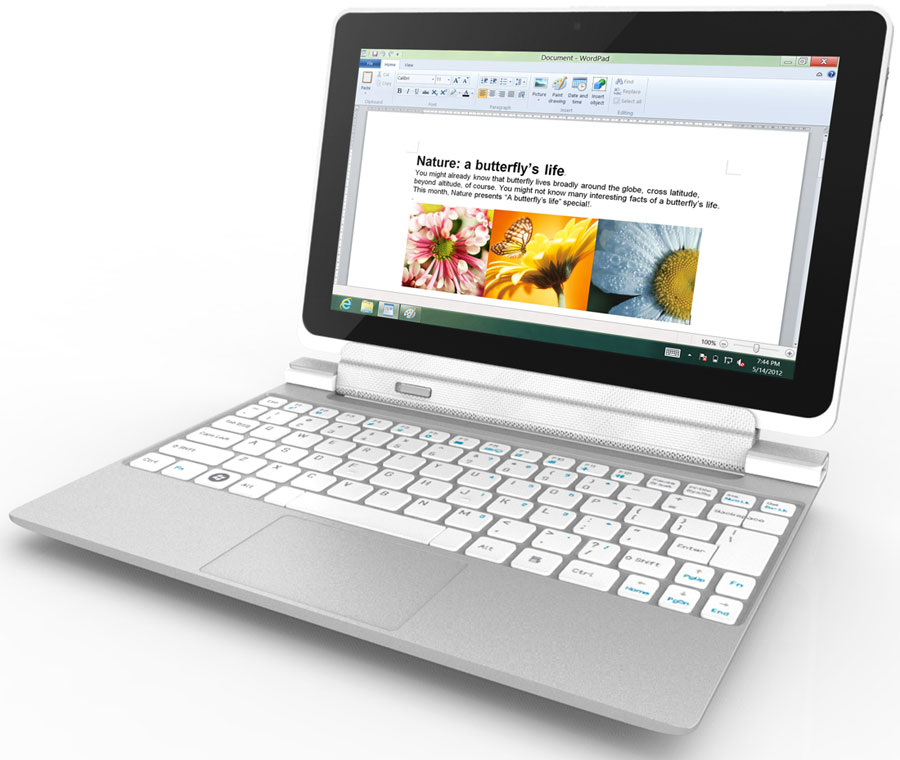
Acer Iconia W510

Acer Iconia W510

(click image to enlarge)

The new devices, due in late October, are tailored for corporate customers, with support for productivity software including Word and Excel, and the ability to connect to peripherals such as printers. The tablets offer the promise of long battery life -- up to 10-plus hours -- while also being capable of streaming high-definition video, making these workhorses suitable for playtime as well.

"With its low-power capabilities and hardware encrypted security, the Z2760 Intel Atom processor opens up a new world of mobile possibilities and transforms expectations about what tablets can do," said Steve Chang, president of ASUS Computer International.

Tablets as Work Machines

Some of the new models will reportedly sport detachable keyboards and a stylus to facilitate content creation, thus filling a spot in the PC tablet space rather than competing in the media tablet space.

"The first tablet implementation was with the PC, and this is moving back in that direction," said Rhoda Alexander, senior manager for monitors and tablets at IHS iSuppli.

"The market is growing and getting ever more diverse," she noted.

"This is one of the things that is expected to give a boost to that market," Alexander told TechNewsWorld. "As far as going head to head with Apple or other media tablets, this is really a different product."

That doesn't mean this won't create competition for Apple in the more general tablet space.

"We have seen the tablet market really pick up steam over the last couple years, but it has really been a one-horse race," said telecommunications analyst Jeff Kagan. "The Apple iPad is in the lead and has crushed big name competitors like Google Android and others. Now Intel is jumping into this space."

Intel Inside

Intel could find itself in a strange place, as it has been quite comfortable in the driver's seat with desktop and notebook PCs for years. But with Microsoft looking to ARM processors for more portable devices that will run on Windows RT, it's clear the market is changing. It appears that Intel is looking to adapt.

Is that going to be easy for a company that has lead by design?

"On one hand, they are already a powerhouse in the same space with regards to computers," Kagan told TechNewsWorld. "On the other hand, tablets are a different type animal -- and they really have to get this right. The Intel brand name will open the door for them, but winning is another story."

Down the road, the tablet market will continue to grow, but others will likely become successful, he added.

"However, we are not there yet. It has been a long and slow road for every competitor other than Apple," Kagan emphasized. "Based on what we have seen so far, I am not holding my breath that Intel will really make a splash."

Opening Windows

Moreover, while Microsoft appears to be hedging its bets with Windows 8 and Windows RT on tablets, Intel is looking squarely at the Atom processor and Windows 8. That bet could pay, as many traditional PC users may want the best of both the desktop and the tablet -- something this operating system could provide.

"This is for those who need the Windows operating system but want touch when they're mobile," said Alexander. "It is showing the response from the traditional PC market to what is happening to the media tablet market. What we see is that media tablet has been on a sharp upward curve, while the others have been treading water.

The trick has been to create a marriage of the two without weighing it down she added. "It still needs to serve the PC users, so a lot will hinge on whether Win 8 delivers."

You are receiving this email because you subscribed to this feed at blogtrottr.com.

If you no longer wish to receive these emails, you can unsubscribe from this feed, or manage all your subscriptions

Friday, September 28, 2012

TechNewsWorld: FTC Wades Deeper Into Online Child Privacy Thicket

TechNewsWorld
TechNewsWorld -- "All Tech, All the Time" // via fulltextrssfeed.com
FTC Wades Deeper Into Online Child Privacy Thicket
Sep 28th 2012, 22:57

An update to the Children's Online Privacy Protection Act, long overdue since the law's enactment in 1998, are nonetheless drawing fire from consumer advocacy groups who contend the changes will further invade children's privacy instead of preventing it. Groups such as the ACLU and Consumer Watchdog have written the FTC in opposition of the current proposed rules.

The Federal Trade Commission is working on an update of the rules governing the online collection of personal information, which have remained pretty much the same since 1998.

The changes to the Children's Online Privacy Protection Act, however, are likely to do as much to invade children's privacy as to protect it.

The proposed changes have been debated since 2009. The ongoing debate led the FTC in August to extend the deadline for comments to Sept. 24.

That drew a fresh spate of comments from advocates earlier this week.

Proposed Changes to COPPA

Section 312.2 of COPPA, known as the 100 percent deletion standard, requires operators to delete all individually identifiable information in postings by children before they're made public.

The FTC is proposing that operators who use technologies reasonably designed to capture all or virtually all personal information input by children should not be deemed to have collected personal information.

In other words, if you collect the information automatically, you get a free pass.

Another change will let operators collect a form of government-issued identification such as a driver's license or a segment of a social security number, from kids' parents to verify their identity.

Further, the FTC proposes allowing operators to collect a parent's online contact information for the purpose of providing notice to, or updating the parent about, a child's participation in a website or online service that does not otherwise collect, use or disclose children's personal information. The parent's online contact information may not be used for any other purpose, disclosed, or combined with any other information collected from the child.

Cookie Problems

"Cookies and other identifiers that online brokers collect to create profiles on individual users are personal information, and such data shouldn't be collected from a child without parental permission," Jeffrey Chester, executive director for the Center for Digital Democracy, told TechNewsWorld.

It's important that the FTC "says that all this data about you and your parents, whether collected from mobile phones or browsers or gaming sites, is considered personally identifiable," Chester continued. "These identifiers should be protected for adults as well."

Websites directed to children "do as much, or even more, tracking as general purpose sites," John Simpson, consumer advocate at Consumer Watchdog, pointed out. "That's why we've urged the FTC to identify persistent identifiers as personal information."

The CDD, the ACLU, and a slew of other groups wrote the FTC on Tuesday calling for stronger protections for kids online.

The letter warned that companies offering children's programs such as Viacom, Time Warner/Turner, and Disney are using advanced state-of-the-art data collection tools to track, profile and target users online.

"The FTC's proposed rules are a welcome attempt to update COPPA, but need further refinement as our coalition suggested, to ensure that children are protected when they go online whether on a PC or a mobile device," Simpson told TechNewsWorld.

The coalition is concerned that some sites could get around the COPPA restrictions by labeling themselves as family-friendly, which would let them avoid regulations that would apply if they were labeled child-directed, Simpson continued.

Members of the coalition include the American Academy of Child and Adolescent Psychiatry, the Berkeley Media Studies Center, Campaign for a Commercial Free Childhood, Center for Media Justice, ChangeLab Solutions, and the Consumer Federation of America.

Don't Tread on My Info

The new rules could jeopardize the privacy and safety of children, child protection advocate Larry Magid warned earlier this week.

Requiring that parents submit a child's name and age to the site operator and the source of videos embedded on sites aimed at children, as proposed by the FTC's planned amendments, will disclose the very information the rule is trying to protect and will make kids more vulnerable, Magid contended.

"The proposed regulations are better than what exist now, but we believe there must be changes from what the FTC proposed, to fully protect children under the age of 13," Consumer Watchdog's Simpson said.

You are receiving this email because you subscribed to this feed at blogtrottr.com.

If you no longer wish to receive these emails, you can unsubscribe from this feed, or manage all your subscriptions

TechNewsWorld: Facebook, Twitter Poke Holes in China's Great Firewall

TechNewsWorld
TechNewsWorld -- "All Tech, All the Time" // via fulltextrssfeed.com
Facebook, Twitter Poke Holes in China's Great Firewall
Sep 28th 2012, 16:02

Today in international tech news: A report on social media use in China shows that the Great Firewall has some holes. Also: In the most recent twist of the Kim Dotcom case, New Zealand's prime minister apologizes for spying; Microsoft can't get on the EU's good side; and RIM's quarterly report was bad -- but not that bad.

Despite government-imposed bans, Facebook and Twitter have tens of millions of users in China, according to London-based GlobalWebIndex.

Facebook use in China has reportedly swelled to 63.5 million people, a roughly eightfold increase over the 7.9 million who used the site two years ago. Twitter, meanwhile, has nearly 36 million users in China.

Facebook and Twitter use among China's 500 million Internet users would likely be even higher but for homegrown alternatives such as Sina Weibo, the country's Twitter counterpart (roughly 300 million users), and Renren, which has been likened to Facebook (roughly 160 million).

Even so, Facebook and Twitter speak to the platforms' popularity in China -- and to the various ways around the Great Firewall.

New Zealand to Kim Dotcom: Our bad

New Zealand's prime minister has apologized to Kim Dotcom, the founder of the file-sharing site Megaupload who was arrested earlier this year in New Zealand.

According to the BBC, the PM apologized because the New Zealand law enforcement agency that spied on Dotcom is only allowed to spy on foreigners. And Dotcom, while originally from Germany, became a New Zealand citizen in 2010.

The mistake is "hugely disappointing," according to the prime minister.

Dotcom was arrested in a January raid that was part of an FBI investigation. U.S. authorities allege that Dotcom headed Megaupload and is responsible for millions of dollars worth of copyright infringement.

The PM apology is but the latest wacky twist in this case. In May, a New Zealand court ruled that the U.S. government had to turn over the evidence it had against Megaupload. In June, a New Zealand judge ruled that the warrants used in the raid of Dotcom's home were illegal. In July, Dotcom's extradition case was delayed until March of 2013. Microsoft Still Drawing EU's Ire The European Union will charge Microsoft for failing to comply with a 2009 ruling that required the company to offer users Web browsers other than its own Internet Explorer.

According to Reuters, a "formal proceeding" will explore the company's breach of the agreement. Microsoft pledged earlier this month to comply with the EU ruling but has apparently failed to appease authorities.

In June, the EU upheld an old ruling against Microsoft, resulting in a $1 billion-plus fine. This current case could be even more costly: According to Reuters, Microsoft faces a penalty of $7.4 billion -- 10 percent of its revenues for the fiscal year ending on June 30, 2012.

RIM Losses Could Have Been Worse

BlackBerry maker Research In Motion announced another quarterly loss Thursday, but it wasn't as bad as expected.

As The Guardian reports, RIM's losses were $235 million in the second quarter, or $0.45 per share. Not great, but better than the $0.47 cents per share loss analysts were expecting.

RIM also announced Thursday that it shipped 7.4 million BlackBerry phones in the quarter, considerably more than the 6.4 million analysts had predicted.

Those nuggets of good news helped send RIM's stock up more than 19 percent in after-market trading.

Thursday's good news -- and small losses constitute good news for RIM -- comes a day after a report that RIM actually picked up subscribers last quarter, buoyed by growth in emerging markets.

You are receiving this email because you subscribed to this feed at blogtrottr.com.

If you no longer wish to receive these emails, you can unsubscribe from this feed, or manage all your subscriptions

TechNewsWorld: Galaxy Note II Poised to Hit the Runway for US Debut

TechNewsWorld
TechNewsWorld -- "All Tech, All the Time" // via fulltextrssfeed.com
Galaxy Note II Poised to Hit the Runway for US Debut
Sep 28th 2012, 14:00

Samsung's save-the-date email leaves little to the imagination, with a stylus occupying the featured position and the tagline "The Next Big Thing Is Here," the event in question has got to be the U.S. launch of its Galaxy Note II. Occupying the space between a phone and a tablet, the Note II is designated as "enterprise-ready."

Samsung on Thursday emailed out a teaser that sparked frenzied speculation about its being a harbinger for the launch of the company's Galaxy Note II phablet.

Galaxy Note II

The Galaxy Note II

The email is titled "The Next Big Thing Is Here," and carries an edge-on lengthwise shot of what appears to be a Samsung Galaxy Note, with the tip of the S pen sticking out from the top.

Recipients are urged to save the date, Oct. 24, at 7 pm, and New York City is given as the venue. A formal invitation is to follow.

"I can confirm that Samsung is holding a press event on Oct. 24 at 7 pm in New York," Samsung Mobile spokesperson Makenzie Blythe told TechNewsWorld.

Specs for the Galaxy Note II

The new device has a redesigned S pen, new S pen apps, and a quad-core 1.6 GHz Exynos processor that's optimized for LTE networks.

The Galaxy Note II is the first Samsung smartphone to launch with Android 4.1, aka Jelly Bean. It's also a SAFE-designated device, meaning it's enterprise-ready.

The Galaxy Note II has a 5.5-inch HD Super Amoled touchscreen with a 16:9 aspect ratio. This screen is 0.2 inches larger than that of the Note I.

Despite having a 3,100 mAh battery that's 24 percent larger than that of its predecessor, the Note II weighs less.

The S pen has been ergonomically redesigned, and can sense 1,024 levels of pressure -- four times as many as the original S pen. The S pen now has "Air View," a feature that lets users preview content in an application by holding the pen in the air above the app.

The Galaxy Note II offers multitasking, including popup windows to take notes using the S pen, and popup video.

The device also incorporates many content-sharing features introduced in the Samsung Galaxy S III. These include "Share Shot," which lets users share pictures taken with the Galaxy Note II's 8 MP camera, with other phones up to 200 feet away; "Burst Shot/Best Shot," and S Beam.

The Galaxy Note II will be available in the United States from Verizon, AT&T, Sprint, T-Mobile and U.S. Cellular, Samsung said.

Projections and Perspective

Samsung kicked off sales of the Galaxy Note II in South Korea on Tuesday, and will roll it out in 128 markets through 260 carriers. The company expects it to sell three times faster than its predecessor.

The Galaxy Note I is claimed to have sold 10 million units in nine months, half of that in the first five months.

"Those five million Notes sold over five months is the same number of iPhone 5s as Apple sold in the first weekend," Carl Howe, a research vice president at the Yankee Group, told TechNewsWorld. "RIM just reported that it sold 7.4 million BlackBerry smartphones last quarter, and RIM's a company many think is close to dead."

Nevertheless, "it's a good number for Samsung and better than most of its non-Apple competitors," Howe continued. Yankee predicts that 708 million smartphones will be sold globally in 2012.

That Old Samsung Je Ne Sais Quoi

It's difficult to figure out just where the Galaxy Note fits into the mobile device market. Other tablets equipped with styluses include the Asus Memo and the Wacom Bamboo.

"It's in a nice little niche between tablets and the 4.3-inch smartphone," Andrew Eisner, director of community and content at Retrevo, told TechNewsWorld. "If they don't get into trouble with Apple over patents, they'll be successful."

The lawsuit between Apple and Samsung may not impact sales of the Galaxy Note II much, but "the iPhone 5 and, possibly the rumored iPad mini may have a significant effect," the Yankee Group's Howe said.

The Galaxy Note II's size and price are "awkwardly in between a smartphone and a tablet," Howe remarked. "I just don't see it finding more than a small niche of consumers who will be interested in a device that tries to be both fish and fowl, regardless of its wide distribution."

You are receiving this email because you subscribed to this feed at blogtrottr.com.

If you no longer wish to receive these emails, you can unsubscribe from this feed, or manage all your subscriptions

TechNewsWorld: iOS 6 Triggers Wonky WiFi Woes

TechNewsWorld
TechNewsWorld -- "All Tech, All the Time" // via fulltextrssfeed.com
iOS 6 Triggers Wonky WiFi Woes
Sep 28th 2012, 12:00

By John P. Mello Jr. MacNewsWorld Part of the ECT News Network 09/28/12 5:00 AM PT

Aside from the Maps app, probably the next most widespread complaint about iOS 6 has been the wireless connectivity issues users have been experiencing. The issue affects users of multiple devices, indicating the problem is most likely with the software. That's good news, because a software fix can be pushed out over the air.

Maps aren't the only thing causing grumbling among the Apple faithful these days. Complaints are piling up about WiFi performance, too.

Customer grousing about WiFi problems has filled 93 pages at one Apple forum with beefs about disabled options, failure to link to corporate networks and logy connections.

After upgrading his iPhone 4S to iOS 6, Adam Nations, communications director for uBreakiFix, a national smartphone repair chain, said he began experiencing WiFi connectivity problems.

"I had a problem connecting to a WiFi network that I had connected to at one of our stores without a problem before," he told MacNewsWorld. However, when he tried to log on as a guest, the connection went through.

Since that time, he has replaced his 4S with an iPhone 5 and hasn't experienced any WiFi problems, although he has encountered snafus with data downloads over LTE.

Download Woes

Some members of Apple's online user communities would have been glad to have Nations' connection problems. That's because they couldn't even get WiFi to work on their phones. Several reported WiFi on their 4Ss being disabled and not being able to re-enable it.

Apple did not respond to our request for comment for this story. However, for a number of the forum members, Apple's solution to the problem was to replace their phones.

Other forum members complained of being unable to connect to corporate networks. In one case, Apple's "genius" support was less than helpful. "Just got off the phone with Apple Support and they recommended the IT department make security WPA changes as well as upgrade their firmware," one user wrote.

Performance tests on the iPhone 5 by ABI Research revealed that WiFi was a sore point in the device, according to the firm's vice president of engineering Jim Mielke. "I saw the problem in the lab," he told MacNewsWorld. "It gets stuck in a very low download rate."

Software Fix Needed?

Ordinarily, an iPhone user should get download speeds of 10 to 15 megabits per second. The iPhone 5, he said, "gets stuck at 300 kilobits per second and basically does almost nothing."

The problem only occurs with downloads; upload performance is normal, he said. "But it's the downlink that you're using most of the time," he added.

ABI's tests suggest software is the source of the problem, Mielke asserted. "It's something with the iOS not communicating properly with the connectivity chips," he said.

"That'd sort of good for Apple because they should be able to fix that with an Over The Air update," he added.

No Hard Data

If the problem is occurring on multiple models and devices, it's reasonable to deduce it's a software problem, according to Rob Williamson, marketing manager for Chipworks. That's because the iPhone 5 is "dramatically different" from previous iPhones inside, he explained.

"If these WiFi problems are occurring across devices, you can conclude it's a software issue because the silicon is quite different between the iPhone 5 and the other devices," he told MacNewsWorld.

Although scores of users are apparently having WiFi problems after updating to iOS 6, many more aren't having any problems at all. "No one appears to have any real numbers on how widespread the problem is," Carl Howe, research director for the Yankee Group told MacNewsWorld.

Howe owns several iPhone and an iPad 3 and hasn't experienced any WiFi problems since upgrading them to iOS 6.

Perils of Rapid Adoption

One reason problems with an Apple iOS can become magnified is because of the swiftness at which they're adopted, he argued. "When most companies release an upgrade, the pace of upgrade is pretty slow," he said.

"What happened here is that 20 percent of all iOS devices were running iOS 6 within a week," he continued. "So the sheer user base that ran the software was huge."

When the number of online complaints are expressed as a percentage of that user base, he reasoned, "it's a really small number."

You are receiving this email because you subscribed to this feed at blogtrottr.com.

If you no longer wish to receive these emails, you can unsubscribe from this feed, or manage all your subscriptions

TechNewsWorld: Chrome for Android Is More Sticky Than Slick

TechNewsWorld
TechNewsWorld -- "All Tech, All the Time" // via fulltextrssfeed.com
Chrome for Android Is More Sticky Than Slick
Sep 28th 2012, 12:00

Pitched as a browser for searching and browsing fast, with accelerated page loading, adjectives like "quick" and "speed" gave me the impression I was in for a Web-based speed record. That was not to be the case. I experienced sticky page scrolling at the image-heavy CNN website compared to scrolling on the stock browser.

Chrome for Android, an app from Google, is available for free at Google Play.

chrome for android

Some of my earliest memories of smartphones are of the hassles involved with getting bookmarks loaded across devices. Why was it that Web properties thought -- and some still think -- you needed different information at your desk from what you wanted on the road? The issue has never been properly addressed -- until now, maybe.

Google's Chrome browser could claim to rectify this perennial problem by syncing viewed pages across devices. I decided to take a good look.

What Is It?

Google's Chrome browser product promises the holy grail: that you can open up a Web page on one device, say your desktop, and then move over to your Ice Cream Sandwich or higher-OS Chrome app-installed tablet -- and continue looking at the same page.

Does it work? I spent a day with it and the short answer is yes, it does. I was able to read pages alternating between both my PC Chrome browser and my tablet. Goal to Google.

The long answer, however is this: You've got to make sure that both devices are set up properly and that you're signed-in to both with the same Google ID.

You've also got to drill way down into the depths of the respective browser's settings. Then you've got to read help pages that don't appear to correspond to current versions.

You also have to remember that it's not only development that's done by teams who don't necessarily talk to each other. So is Help Page writing.

Still, it did work. I could flip from one device to the other.

Comparing It to the Desktop Chrome Browser

Google pitches Chrome as being a browser for your devices that's just like the one on your PC. After the relative joy of discovering Web page sync worked, I was disappointed to find that the Chrome Web Store was missing on the Android version.

The Chrome Web Store, for the uninitiated, is a set of plug-ins that Google confusingly calls "apps." They include RSS readers and TV feeds among others, and they are neat ways to get content into the browser.

The lack of Chrome Web Store is not the only thing that makes Chrome for Android distinctly unlike the Web browsers on my computer; there's also its conspicuous lack of Flash player.

Missing Flash is a reason to consider other Android browsers out there, including Opera and Dolphin products. Although -- giving Google the benefit of the doubt -- Adobe's Flash video standard is on its way out at the mobile level.

Comparing It to Other Browsers

Speed is another area where Chrome for Android hiccupped. Pitched as a browser for searching and browsing fast, with accelerated page loading, adjectives like "quick" and "speed" gave me the impression I was in for a Web-based speed record. That was not to be the case. I experienced sticky page scrolling at the image-heavy CNN website compared to scrolling on the stock browser.

A perusal of Google's Chrome for Android Known Issues Web Page came up with documented laggy scroll and zoom issues with heavy and dynamic content.

Not Quite There Yet

I desperately wanted to love Chrome for Android, but it was not to be. The sticky page scrolling on its own was enough for me to drop it after a day. My instincts tell me that this is simply an immature product, though, with star potential.

Promises from Google that the laggy scrolling on some hardware will be corrected, and the speedy adjective-laden sales pitches make this app one to watch.


Patrick Nelson has been a professional writer since 1992. He was editor and publisher of the music industry trade publication Producer Report and has written for a number of technology blogs. Nelson studied design at Hornsey Art School and wrote the cult-classic novel Sprawlism. His introduction to technology was as a nomadic talent scout in the eighties, where regular scrabbling around under hotel room beds was necessary to connect modems with alligator clips to hotel telephone wiring to get a fax out. He tasted down and dirty technology, and never looked back.

You are receiving this email because you subscribed to this feed at blogtrottr.com.

If you no longer wish to receive these emails, you can unsubscribe from this feed, or manage all your subscriptions

TechNewsWorld: Easing the Pain After a Security Breakdown

TechNewsWorld
TechNewsWorld -- "All Tech, All the Time" // via fulltextrssfeed.com
Easing the Pain After a Security Breakdown
Sep 28th 2012, 12:00

In the case of a data breach, prevention isn't always possible despite the best efforts of those charges with maintaining security. It's important to remember as well that a well coordinated and planned response after the fact is essential to limiting damage and recovering from the attack.

With each major public data breach our attention focuses on how to prevent these incidents. A good example is the recent security breach at LinkedIn, in which millions of passwords were stolen. Industry experts and the media immediately started to dissect what LinkedIn had done wrong or what methods or tools should have been used to prevent the incident. Unfortunately, at some point every organization will be faced with a security breach. This raises the question -- are security professionals focusing on prevention at the expense of damage control preparation?

Incident response management can be described as the oft-neglected flipside of the security coin. When done right, like in the case of LinkedIn, incident response management becomes another weapon in an organization's prevention arsenal -- in this case prevention is focused on limiting material or reputational damages caused by data breaches. LinkedIn's response was swift, offered sufficient information about the scope of the breach, as well as measures that it had been taken to minimize the impact on its user community. Thus, the company's valuation did not suffer as illustrated by its steadily climbing stock price.

So what are the basic requirements and planning involved in developing a pro-active incident response plan?

The Basics

Incident response management is an organized approach for addressing and managing the aftermath of a security breach or attack -- aka an incident. The objective is to manage the situation in a way that minimizes damage and reduces recovery time and costs. As part of incident response management, an organization should establish a policy that defines in detail, what constitutes an incident and provides a step-by-step process to be followed when an incident occurs.

The US-CERT and SANS Institute have assembled best practices related to the creation of an incident response team. This carefully selected group should, in addition to security and general IT staff, include representatives from legal, human resources, and public relations departments.

According to the SANS Institute, there are six main steps to handling an incident effectively. The preparation phase includes policy development, logging review guidelines, disclosure practices, tabletop exercises, compliance integration, and ongoing training of users and IT staff. Steps two through five focus on how to respond to a security breach itself and are broken down into identification, containment, eradication and recovery.

These steps entail incident classification, digital forensics, malware analysis, system restoration, and public disclosure. The final step is related to post-incident analysis, which is important for identifying lessons learned, document gaps, and necessary enhancements using a closed-loop process.

To successfully implement a pro-active incident response management process, securing buy-in and support from senior management is required. Incident response management needs to be taken seriously and cannot be treated as an ad hoc process that can be abandoned in the next round of budget cuts.

When the Rubber Meets the Road

This all sounds straightforward and should be simple to implement -- at least on paper. However, this process typically breaks down when an incident occurs and a response is required. For example, will members of the incident response team remember their duties and fellow stakeholders when they receive a call on a Saturday at 4 a.m.? The answer most likely is no. So what makes incident response management in the field so difficult?

Policies and stakeholder information are often contained in multiple and dispersed documents, which makes it challenging to quickly access when a security breach occurs. This results in a delayed response. Furthermore, a manual incident response process requires human interaction to share information and alert stakeholders, which leads to further response time delays. The basic lack of alerting and escalation functions often leaves an organization vulnerable.

Another major pain point is prioritizing the remediation response. It is particularly important for organizations to determine the order in which the incident remediation needs to occur. This should be done based on the risk and business impact. With no automation solution in place this calculation is simply not possible. Once the organization has determined its incident remediation strategy, the next step is to track how long the remediation will take, who is responsible, and who will take action. Without interconnectivity into remediation systems and a centralized repository of this data, it becomes almost impossible to determine how effective the remediation actions have been.

Ultimately, the biggest challenge associated with incident response management is documenting the entire process. In many instances, once the incident is identified by one group, the remediation actions are executed by a different group. Typically, there is no audit trail to track the remediation efforts or a process designed to centralize all related documents in one repository.

Taking It to the Next Level

It's clear that relying solely on human interaction and dispersed systems can lead to major deficiencies that can slow down an organization's responsiveness. This will ultimately impact its public reception and escalate damages caused by a security incident. To overcome these shortcomings and streamline the overall process, progressive organizations are leveraging incident response management software. This allows for automation and centralization of the incident response process and creates an audit trail for compliance reporting.

Advanced incident response management software helps organizations collect data from a variety of security and IT tools as well as other applications such as Microsoft Excel spreadsheets. It then aggregates the data and automatically calculates the preliminary risk and business impact, enabling an organization to prioritize the response plan actions and timing.

These systems also route and assign incidents based on type, severity, or affected assets; alert the assigned stakeholders and provide for escalation if needed. Ultimately, all remediation efforts are tracked and all of the collected data is leveraged to measure controls and policy effectiveness as part of the incident post analysis.

By automating and centralizing manual processes, organizations can take a proactive approach to data breaches, transforming incident response management into a preventive measure much the way that LinkedIn did.


Joe Fantuzzi is president and chief executive officer for integrated risk management vendor Agiliance.

You are receiving this email because you subscribed to this feed at blogtrottr.com.

If you no longer wish to receive these emails, you can unsubscribe from this feed, or manage all your subscriptions
Powered by Blogger.
 
topmobile-phone Copyright © 2009 Blogger Template Designed by Bie Blogger Template